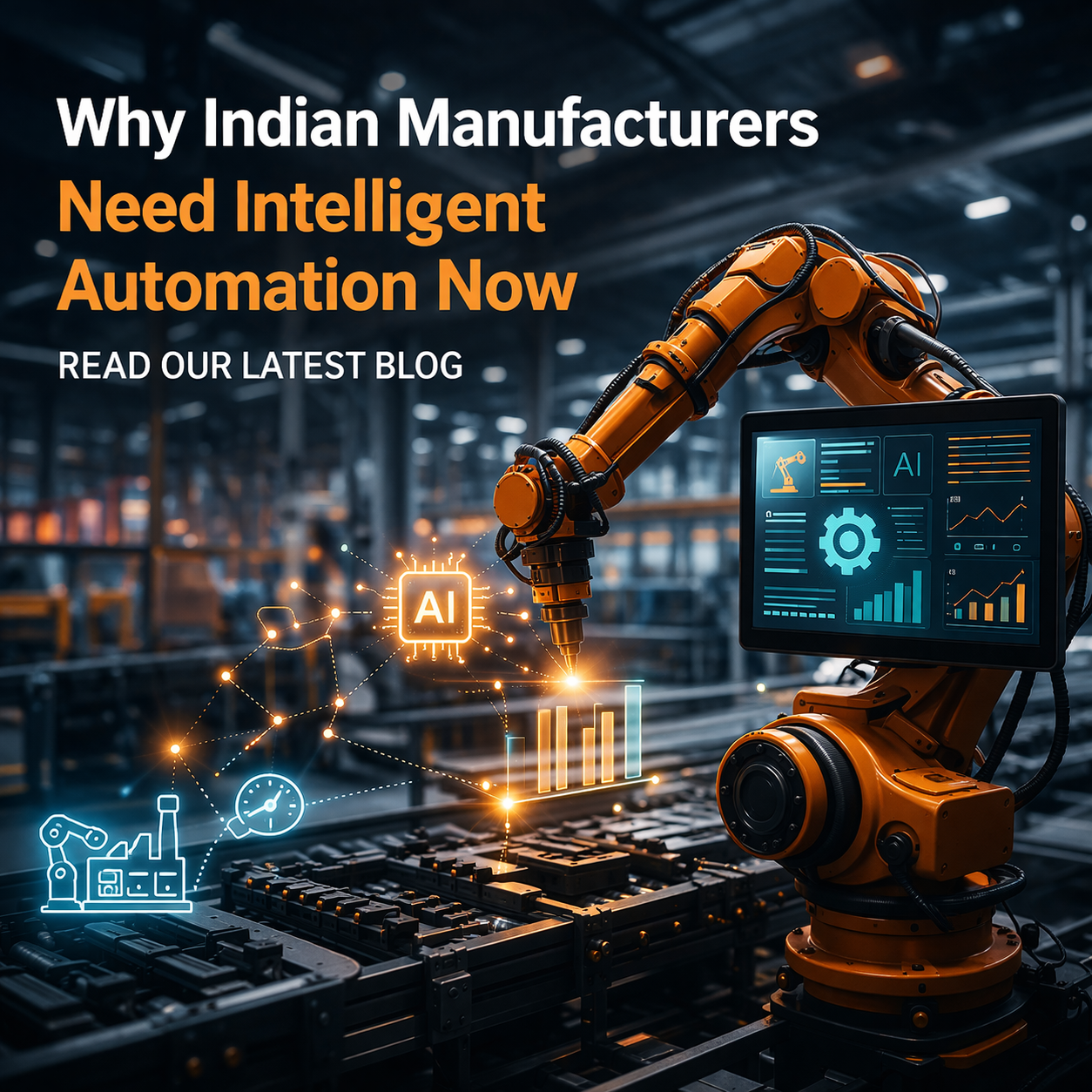
India’s manufacturing sector is at a pivotal moment. With increasing global competition, rising operational costs, and the push toward digital transformation, manufacturers must rethink traditional processes. Intelligent automation—powered by Artificial Intelligence (AI), Industrial IoT (IIoT), and data analytics—is no longer a future investment; it is an immediate necessity.
The Changing Landscape of Indian Manufacturing
India is positioning itself as a global manufacturing hub through initiatives like Make in India and the Production-Linked Incentive (PLI) schemes. While these initiatives have accelerated growth, they have also increased expectations around efficiency, quality, and scalability.
Manufacturers today are expected to deliver faster, maintain consistent quality, and optimize costs—all while dealing with supply chain disruptions and labor challenges. Traditional manual processes are no longer sufficient to meet these demands.
What is Intelligent Automation?
Intelligent automation combines advanced technologies such as AI, machine learning, robotics, and real-time data monitoring to automate complex industrial processes. Unlike basic automation, it enables systems to learn, adapt, and make decisions with minimal human intervention.
From machine monitoring and predictive maintenance to digital twins and smart analytics, intelligent automation empowers manufacturers with real-time visibility and control over their operations.
Why the Urgency?
- Rising Operational Costs
Energy, labor, and raw material costs are steadily increasing. Intelligent automation helps optimize resource usage, reduce waste, and improve overall efficiency—leading to significant cost savings. - Demand for Higher Productivity
Global competition requires Indian manufacturers to increase output without compromising quality. Automated systems can operate 24/7 with precision, reducing downtime and improving throughput. - Workforce Challenges
The industry is facing a skill gap, especially in managing advanced machinery and digital systems. Intelligent automation reduces dependency on manual labor while enabling workers to focus on higher-value tasks. - Need for Real-Time Decision Making
In today’s fast-paced environment, delayed decisions can result in losses. Automation systems provide real-time insights, enabling quicker and more informed decision-making. - Global Quality Standards
To compete internationally, manufacturers must adhere to strict quality standards. AI-driven quality inspection systems ensure consistency and reduce defects.
Key Benefits of Intelligent Automation
- Predictive Maintenance: Identify equipment issues before failures occur, reducing downtime.
- Operational Efficiency: Streamline processes and eliminate inefficiencies.
- Enhanced Safety: Monitor workplace conditions and reduce risks to workers.
- Data-Driven Insights: Turn raw data into actionable intelligence.
- Scalability: Easily expand operations without proportional increases in cost.
The Role of Smart Solutions Providers
Indian manufacturers are increasingly partnering with solution providers that offer AI-driven industrial automation, IIoT systems, and custom applications. These solutions integrate seamlessly with existing infrastructure, enabling a smooth transition toward smart manufacturing without disrupting operations.
From conveyor monitoring and energy management to fleet tracking and digital twins, intelligent solutions are transforming shop floors into connected, efficient ecosystems.
Conclusion
The shift toward intelligent automation is not just a technological upgrade—it is a strategic move for survival and growth. As India continues its journey toward becoming a global manufacturing powerhouse, embracing automation will be key to staying competitive.
Manufacturers who act now will gain a significant advantage in efficiency, cost optimization, and innovation. Those who delay risk falling behind in an increasingly digital and data-driven world.
The future of manufacturing in India is intelligent, connected, and automated—and the time to adopt it is now.
Leave a Reply